Showing posts with label politics. Show all posts

Friday, January 21, 2022

Using Political Party Manifestos to Investigate the Relative Importance of Industrial Relations Ideas in Politics

Note: if you'd prefer an animated version of this posting, see:


Before almost any major election in democratic countries, each political party publishes its manifesto which declares the party’s values, goals, and policies it will pursue if elected. In order to fully inform candidates from that party as well as voters, manifestos comprehensively cover a wide range of topics. Researchers have created ways of categorizing these topics to study them. In fact, researchers from the Comparative Manifesto Project have assembled a data set of manifestos for over 1,000 parties from more than 50 countries across 700 elections. The earliest manifestos in the data generally date back to each country’s first postwar national election, so some start in the 1940s with other countries coming into the data set in later years. The data include countries from five continents. 

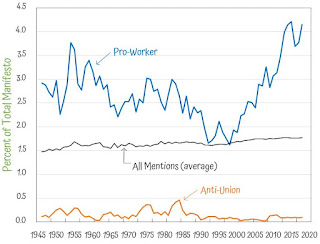
The key variables in this data indicate what fraction of a manifesto’s statements pertain to each of 56 possible topics, some of which distinguish between positive and negative mentions. Across all of the manifestos, welfare receives the most attention, on average. Our focus is on work-related mentions; more specifically, the “Labour Groups: Positive” and “Labour Groups: Negative” categories. The positive category includes pro-worker ideas, like calls for more jobs, fair wages, good working conditions, and stronger labor unions. The negative category almost exclusively consists of anti-union statements.

Across all years and countries, parties dedicated about 2.8 percent of their manifestos to labor groups positive topics—that is, pro-worker ideas—and 0.15 percent labor groups negative topics—that is, anti-union ideas. While these might seem like low rates of industrial relations content, ultimately what matters is the relative importance of these categories compared to others, and the implications of variation in these categories across time, place, and parties. Over time, there was a decline in pro-worker mentions in the 1980s and 1990s, but since then there has been a resurgence, and today pro-worker mentions are more common in manifestos now than they were even during what might be considered the heyday of the labor movement following World War II. Anti-union party platforms are consistently less prevalent, but there have been some periods with greater anti-union attention, such as in the 1970s and 1980s which include the anti-union platforms of Thatcher’s conservatives in the UK.

To think about these dynamics more deeply, we contend that political party manifestos are ideational documents. They are not simply a listing of policy proposals. Rather, a manifesto provides the means for a political party to give meaning to its platform, and allows politicians, policy makers, and voters to more deeply understand a party’s platform. In other words, it embodies ideas about the issues a party sees as important, and attempts to use these ideas to persuade others that these are the best ways to think about those issues.

But where do a manifesto’s ideas come from? We theorize three channels. One, party manifesto ideas on work-related issues may be rooted in a party’s entrenched values based on longstanding historical traditions, ideologies, or beliefs about work and workers. Parties that are ideologically farther left are expected to have greater pro-worker content, while manifestos will be more relatively anti-union among right-leaning parties due to their core beliefs. Two, industrial relations ideas can end up in party manifestos due to new thinking that reflects deviations from the party’s longstanding ideological positions. Three, ideas can arise in party manifestos because of the reactive mirroring of ideas to which the party believes voters will be most receptive, usually in an attempt to gain political power. If voter interests shift regarding how work should be governed, so too might the ideas placed within a party’s manifesto, reflecting an attempt to demonstrate commitment to the new interests of their constituents. 

We use these three channels to motivate statistical analyses of the frequency of pro-worker and anti-union ideas in political party manifestos using the Comparative Manifesto Project data combined with other measures that we merge in, although we cannot directly observe the three channels. Specifically, we estimate OLS regression models with two dependent variables: the percent of pro-worker and anti-union mentions in a manifesto. Depending on data availability, our regressions have between 2,000 and 4,500 observations. 

With respect to party family, socialist parties have the largest average pro-worker mentions, followed by social democratic parties, just as one would expect. Looking first at a party’s enduring ideology as reflected in its mean ideology across all elections, parties that are more right-leaning have fewer pro-worker mentions than left-leaning parties, even controlling for the party family, but there are mixed results for deviations from long-term ideology. These results suggest that entrenched values are an important foundation for political parties’ ideational strategies pertaining to work while the support for the new thinking or reactive mirroring channels is not as strong. We also explore the explanatory power of other measures relating to party extremism, parties’ responses to competitors, labor movement and economic conditions, and political systems characteristics. 

But do voters care about work-related mentions? Yes. We find that more pro-worker mentions predicts greater votes and seats won in an election, and pro-worker ideas is one of only 7 (out of 56) manifesto categories correlated with greater vote share. 

In conclusion, political parties are under-researched actors in industrial relations, and we hope that this study of their ideas spurs additional research into the importance of political parties in industrial relations. With respect to the emerging scholarship on ideas in industrial relations, we’ve tried to illustrate that political manifestos are useful documents for capturing ideational thinking that are unadulterated by necessary legislative or political compromises required to govern. Methodologically, we hope our large-n analyses shows that quantitative analyses can make unique, complementary contributions to the qualitative literature. For example, our finding of an enduring use of pro-worker ideas paired with more episodic deployments of anti-union ideas could be hard to see in a focused, qualitative study. This should also serve as an indicator that there are consistencies in ideas over time such that ideational research needs to incorporate theories of long-term stability with theories of shorter-term change. Conceptually, the three-channel framework sketched here for thinking about the ideational content of manifestos can also be applied employers or unions. As the environment changes, how do they navigate the tensions between staying true to their core ideas, introducing new ideas, and being responsiveness to what their constituencies want?


Source: J. Ryan Lamare and John W. Budd (forthcoming) "The Relative Importance of Industrial Relations Ideas in Politics: A Quantitative Analysis of Political Party Manifestos across 54 Countries," Industrial Relationshttp://doi.org/10.1111/irel.12296 [free access to the pre-publication version here].

Monday, September 20, 2021

The Importance of Political Systems for Trade Union Membership, Coverage, and Influence

Here's the Twitter thread version of my new article:

Excited that “The Importance of Political Systems for Trade Union Membership, Coverage, and Influence: Theory and Comparative Evidence” with @jryanlamare is in the current BJIR issue. https://doi.org/10.1111/bjir.12575
1/

Ideological links between the state & industrial relations have-of course-been recognized as important for a long time. We build on this to consider the influence of the structural nature of a country’s political system, irrespective of the ideological leaning of the state.
2/

By political system, we mean 1) the extent to which a national electoral system yields a legislative body that is (dis)proportional to the fraction of votes each party received, 2) effective number of parties, 3) multiparty ruling coalitions.
3/

We theorize that these can influence workplace-level unionism, holding state ideology constant, via incentives for inclusionary governance & legislative body diversity. In short, a pol. system that rewards compromise rather than competition may create similar workplace norms.
4/

Eg, in more representative & coalitional systems, unions have more opportunities to use their extra-parliamentary status to act as consensus-builders, increasing their legitimacy. Also, employers have incentives to influence as a social partner, so can't bust unions.
5/

Using @eurofound establishment data & @ESS_Survey individual data for 25+ European countries, increased political representativeness (lower disproportionality,  coalitions) is a statistically significant predictor of a greater likelihood of individual trade union membership.
6/

And competitive fragmentation, measured by greater numbers of political parties, is associated with weakened collective voice. Causal ambiguity is likely the strongest for the multiparty coalition outcomes.
7/

The importance of cross-national institutional differences in the nature of trade unions & workplace voice, supportive legislative policies, and varieties of capitalism needs to be complemented by a deeper understanding of the role of varieties of political systems.
8/

Article: https://doi.org/10.1111/bjir.12575
Non-paywall version: https://papers.ssrn.com/sol3/papers.cfm?abstract_id=3425452
9-minute animation (fewer details, more fun): https://youtu.be/K_mP-htYcok
And we are deeply touched by the care shown to us & our work by the late David Marsden who was the editor.
9/9

Thursday, November 5, 2020

How the U.S. Political System Might be Bad for Labor Unions Regardless of Who is in Power

Speaking of elections….it’s fairly obvious that whether Democratic or Republican politicians control local, state, or federal policy-making has important implications for future outcomes on wide-ranging issues, including employment-related outcomes like labor union strength. But recent research with Ryan Lamare suggests that regardless of which party is in power, the structure of the U.S. electoral system might also shape the strength of labor unions.

In our research we look at three measures of a country’s political system: (1) disproportionality, measuring (the inverse) of representativeness as captured by the discrepancy between votes and seats received, (2) the effective number of political parties, measuring fragmentation in a political system, and (3) whether or not there is a coalitional government. France is an example with high disproportionality scores—for example, President Macron’s party has more than 50 percent of the seats in the French National Assembly even though it only received 28 percent of the votes—while Belgium is an example of a large number of parties—currently, twelve different political parties currently have seats in the Belgian Chamber of Representatives.

Using multiple European data sets at both the individual and establishment level, we generally find that countries that labor unions are stronger and have more members when a political system is more representative, less fragmented, and governed by a coalition—regardless of the ideology of the ruling party or parties. 

Why might this be the case? We can’t observe specific reasons in our analyses, but we articulate several possibilities. In more representative and coalitional political systems, it is difficult for any single party to govern or have outsized influence. In such systems, then, inclusionary governance arrangements are often required to attain political power, whereas in less representative and unilateral political systems, parties can be exclusionary in their governance. Under more representative and coalitional systems, unions have greater opportunities to use their extra-parliamentary status to act as consensus-builders, thus enhancing their legitimacy and value. Moreover, because it is difficult for any single party to govern in representative and coalitional electoral systems, employers have an incentive to seek influence as a social partner rather than relying on influence within specific political parties. In other words, there is a greater incentive for employers to embrace a culture of inclusion and compromise that recognizes rather than attacks the legitimacy of labor unions.  All of these mechanisms can happen when the ideology of the legislature or ruling coalition is either right- or left-leaning.  

On the other hand, when there are a large number of fragmented parties, smaller extremist parties can compete for relatively outsized power, this may make creating a spirit of consensus-building and compromise difficult. Instead we expect a competitive social climate in which unions are attacked. A large number of competitive parties could also create political gridlock, reinforcing an overall culture of competition rather than inclusion. 

In an earlier posting, I applied this to last year's UK election, and estimated that if the UK had proportional representation electoral rules, the chances of individual union membership would be higher by 2 to 9 percentage points than is currently the case under its highly disproportional system. 

But where does the United States fit in? Numerically, the two-party system suggests a lack of competitive fragmentation, but recent experience suggests a great deal of polarization in spite of only two major parties. So labor unions become a partisan combatant in vitriolic contests rather than a consensus builder. The lack of coalition governments further denies labor unions this avenue for enhancing its legitimacy. In terms of representativeness as captured by disproportionality, the picture is cloudy. The U.S. House of Representatives typically scores favorably (that is, high proportionality / low disproportionality). In 2018, for example, the Democratic candidates garnered 53.4 percent of overall votes and ended up with 54 percent of the seats. But over the previous three elections, Republican Senate candidates received 44 percent of the vote but Republicans control 53 percent of the seats, resulting in a high disproportionality score of 8. And for the presidency, the electoral college can lead to even greater discrepancies. Unfortunately, this complicated U.S. electoral system doesn’t fit well with the European systems we analyzed in our research. But the above-average levels of disproportionality in the Senate and electoral college are consistent with the U.S. political system not being one of compromise and inclusion that our research suggests indirectly benefit the legitimacy of labor unions.

Even though it might be a stretch to our apply our results to the U.S. context, we think it’s important to continue to consider how the nature of a country’s political system may impact issues that are not typically considered, such as the legitimacy of a country’s labor movement. Some have used the 2020 presidential election as a platform for arguing the need to abandon the electoral college. Our research highlights that election rule reforms can have effects far beyond the obvious. Consequently, reforms could be even more valuable than realized...or full of unintended consequences. Only by thinking through these deeper effects can we get a better handle on this. 


Source: John W. Budd and J. Ryan Lamare (forthcoming) "The Importance of Political Systems for Trade Union Membership, Coverage, and Influence: Theory and Comparative Evidence," British Journal of Industrial Relations. https://doi.org/10.1111/bjir.12575. [free access to the pre-publication version here]

Wednesday, December 18, 2019

Legislative Election Rules and Industrial Relations—Representativeness is Good

Last week’s UK parliamentary election has highlighted the importance for election rules for determining the representativeness of a legislative body. In particular, the Conservative party won 56 percent of the seats in Parliament while only receiving 44 percent of the votes cast. The Labour party’s representation better matches its vote share (a 32 percent vote share yielded a 31 seat share), but the Liberal Democrats were left with not even two percent of the seats in spite of receiving more than 11 percent of votes. So the composition of seats in Parliament is not very representative of the distribution of votes across the electorate.

These mismatches were further highlighted when the Electoral Reform Society simulated the results if the UK followed the proportional representation electoral rules used elsewhere in Europe. It found that the Conservatives would have won 288 instead of 365 seats, Labour 216 instead of 202, and the Social Democrats 70 instead of 11 (though the Church of Militant Elvis party still would not won any seats). Under these proportional representation election rules, the composition of seats in Parliament would be strongly representative of the nature of the votes cast (e.g., Conservatives with 44.3 percent of the seats based on 43.6 percent of the votes).

This is not a matter purely for the political sphere. Ryan Lamare and I have been working on a research project that analyzes the connection between election rules (representativeness) and industrial relations—specifically, linkages to the extent of workplace employee representation such as labor unions and union membership. Theoretically, we identify multiple ways in which political representativeness might shape employee representation, including enacting public policies, involving unions in peak-level corporatist initiatives, enabling direct relationships between trade unions and legislators, shaping attitudes around political inclusion that affect workplace agency, and giving social legitimacy to collective voice. Through all of these channels, a political system with greater representativeness is expected to have stronger workplace employee representation and higher rates of union membership.

But what happens in practice? Political scientists have developed measures of legislative representativeness, and we focus on a measure called “disproportionality.” In short, this measures the magnitude of the deviations between seat and vote shares. With a baseline of perfect proportionality (seat share = vote share) of zero, then greater deviations yield a higher disproportionality score. The disproportionality score for last week’s UK election is 11.9—this is actually lower than in recent UK elections but is much higher than in many European countries (for example, the disproportionality score is typically less than five in Belgium, and less than two in Denmark). France is another European country with high disproportionality scores—for example, President Macron’s party has more than 50 percent of the seats in the French National Assembly even though it only received 28 percent of the votes (maybe this is connected to all of the worker protests in France?). [Curious about other country's values? Choose any election here and look for “Disp” in the lower right corner.]

We can then statistically analyze the predictive power of disproportionality scores across European countries between 2002 and 2016. We generally find that disproportionality is negatively related to the presence of trade unions and other representative bodies in the workplace, the existence of a collective wage agreement, and the likelihood of individual union membership. In other words, consistent with the predictions of our theory above, greater representativeness in a country’s legislative body is linked to greater workplace representativeness. We can’t observe exactly why, but we think that it’s because a culture of compromise and inclusion at a legislative level spills into other spheres, including the workplace.

In fact, our results suggest that what happens at the electoral level is quite important for industrial relations. Returning to the recent UK election, using the distribution of hypothetical seats that the Electoral Reform Society calculated would have resulted using proportional representation electoral rules, we calculate that the disproportionality score would have been only 1.4 instead of the actual 11.9. This is a very low score indicative of a highly representative outcome. Using a back of the envelope calculation, then, our statistical results imply that this reduction in disproportionality (using the proportional representation election rules) would increase the chances of individual union membership in the range of 2 to 9 percentage points. Note that the union membership rate (“union density”) in the UK is less than 25 percent, so this hypothetical change is not trivial. Those interested in the world of work and employee representation should pay more attention to election rules.


Source: John W. Budd and J. Ryan Lamare (forthcoming) "The Importance of Political Systems for Trade Union Membership, Coverage, and Influence: Theory and Comparative Evidence," British Journal of Industrial Relations. https://doi.org/10.1111/bjir.12575. [free access to the pre-publication version here]

Monday, November 7, 2016

Industrial Relations Sadly Chuckles on the Eve of the Election

It’s hard to find many people happy with the choices in tomorrow’s U.S. presidential election. Setting aside the troubling personal qualities that have been so apparent, it’s difficult not to be leery (at best) of Trump’s populism-at-its-worst and Clinton’s elitist-insider-insularity. If only both sides had paid more attention to industrial relations values and institutions over the past several decades rather than actively destroying them (Reagan, Thatcher, Walker, etc.) or just giving them lip service (Clinton, Obama, etc.), then maybe we wouldn’t be in this mess.

Industrial relations values embrace the sanctity of human dignity for all workers and their communities, and respect the needs of stakeholders with distinct interests and unequal power. This means that markets—whether labor, financial, or otherwise—don’t work for everyone, and the sanctity of free markets should be rejected. Industrial relations institutions therefore seek to bring a greater balance to the marketplace to help them work better for all by balancing efficiency, equity, and voice, often in collective rather than atomistic ways. The classic example is collective bargaining which (ideally) brings solidarity to the workforce and empowers them with a voice, but requires bargaining, often at a local level, in which a business’s needs can be addressed and balanced with workers’ interests.  

But for whatever set of complicated reasons, these industrial relations values and institutions have been weakened over the past several decades, and the academic field of industrial relations has shrunken as well. Instead, individualism, personal responsibility, and free market thinking dominate. Workers were assured that the benefits of free trade, deregulation, and increased financialization would trickle down and lift all boats, and that everyone would have the opportunity to work with purpose and meaning if they adopted the right mindset.

Instead, many have been left behind as illustrated by the sharp increase in inequality since the 1980s, and we live in polarized and polarizing times. Economic insecurity seems to frequently bring out the worst in people. And thus we have a distasteful form of populism that seeks to blame other workers and shut others out rather than building solidarity, respect, and inclusion. And we have anti-elitism which becomes anti-intellectualism and contempt towards science, education, and the arts as well as towards good government. Again, rather than bringing society together, fault lines emerge.

At a fundamental level, this disaffection is what industrial relations seeks to avoid. The construction and maintenance of institutions that provide checks and balances would have provided greater equity so people don’t feel left out, and greater voice so that people feel more on equal footing with the elites. But this would have required an embrace of industrial values around solidarity, inclusion, voice, pluralism, and compromise rather than individualism, self-interest, and free markets driven by insider elites.

Perhaps the consequences of the marginalization of industrial relations are now coming home to roost. On the Republican side of the aisle, the threat to the Republican establishment presented by the popularity of Trump has arisen out of disaffection with the Republican Party’s inability or unwillingness to replace the earlier industrial relations system with something that provides equity and voice instead of just individualism and free markets. On the Democratic side of the aisle, the skepticism towards another Washington insider is similarly rooted in policy making that has been top down rather than inclusive, and seemingly benefiting financial interests more than worker and community interests. Indeed, were the seeds of each's side demise planted, at least partly, by their own marginalization of industrial relations? 

Those who embrace the industrial relations ethos are probably thinking “I told you so.” But it’s a sad chuckle indeed.